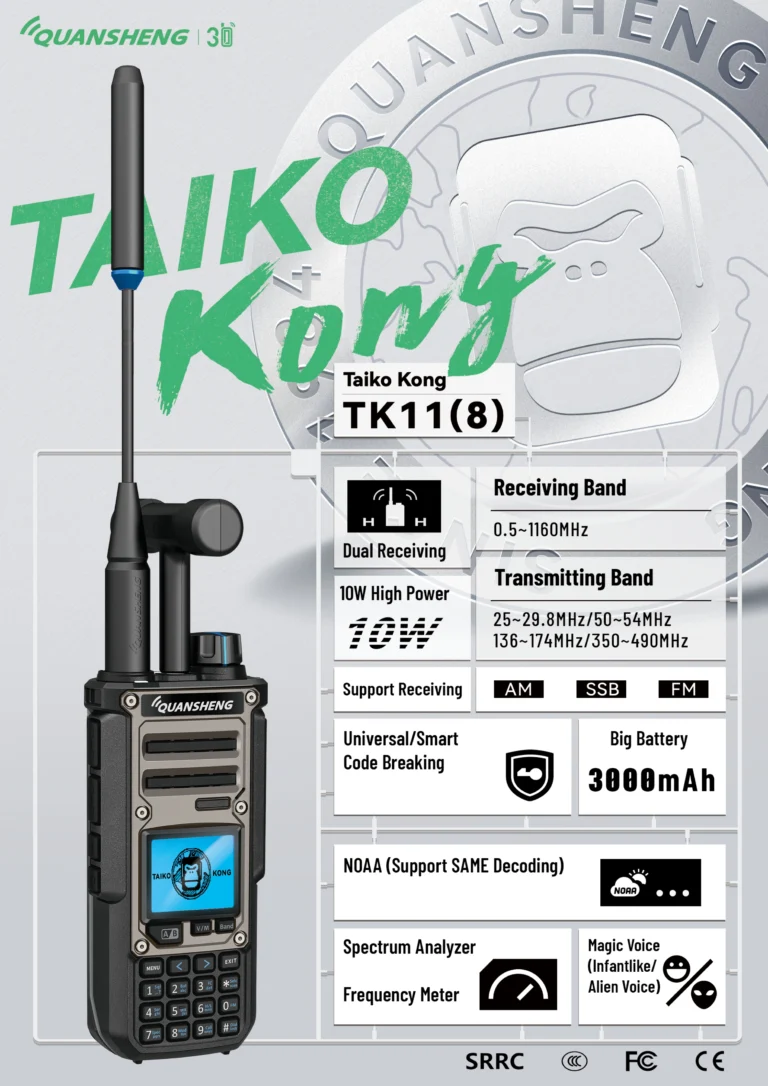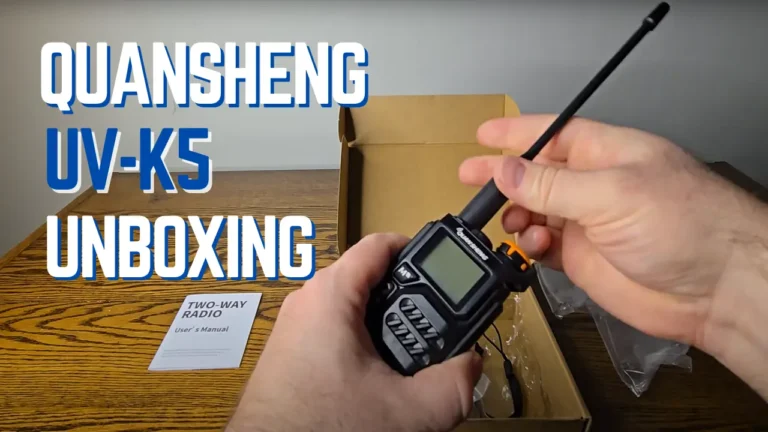
When I started searching for my first handheld radio last year, I looked at the UV-K5 specifications (below) as well as the specs from several other radios.
Baofeng seems to be the undisputed champion of cheap Chinese handhelds radios / walkie talkies these days, at least on Amazon, but as soon as I heard Quansheng radios were “hackable”, I just knew I had to try one.
Ultimately I bought a variant of the UV-K5 called the UV-K5(99), (more on that later) but I kinda wish I’d just stuck with Quansheng’s classic UV-K5 instead. Here’s everything you get with a stock Quansheng UV-K5.
UV-K5 Specs Highlights
I’ve got the full specs below for all the super nerds out there, but for the regular Joes just trying to sort through all the feeds and speeds and bits and bytes, here are the main things you need to know about the UV-K5:
It Receives NOAA Alerts
NOAA Weather Radio is a 24x7x365 emergency broadcast service that covers the entire United States, including US territories, coastal waters and more. In addition to weather alerts, the NWR also broadcasts other environmental alerts like chemical spills, earthquakes, amber alerts, etc.
During a large natural disaster you might lose power, Internet, cable TV, and cell service, but NWR SHOULD still remain online.
The United States only uses 10 frequencies for the NOAA, and the Quansheng UV-K5 specs say this radio will store all of them.
The UV-K5 transmit frequencies are ham-only…
Right out of the box, a UV-K5 bought in the United States only transmits on the two most common ham radio frequency bands:
- 144Mhz to 148MHz (VHF) – also known as the “2 meter band,” in reference to the corresponding wavelength of these frequencies
- 420MHz to 450MHz (UHF) – also known as the “70cm band”
According to these UV-K5 specs from the manual, a radio bought elsewhere should be able to transmit on wider bands:
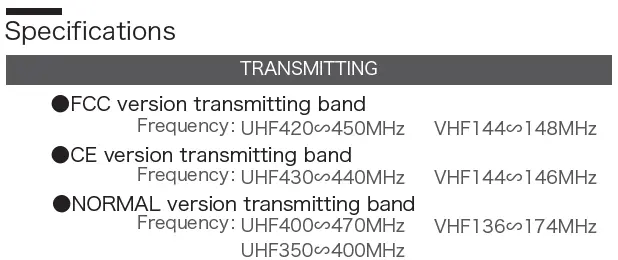
…But you can unlock more
It depends on which Quansheng radio you end up with and what firmware you put on it, but these radios are capable of transmitting on a lot more frequencies than are listed above.
Technically, the UV-K5 can use other frequencies like FRS, GMRS, MURS, and others but it’s not legal to use a radio like that in the United States.
The UV-K5 can hear A LOT
The UVK5 specs say this radio picks up almost everything in the 50MHz-600MHz range, which means you should be able to hear :
- Police/Fire/EMS dispatch
- AM/FM radio stations (FM comes in better)
- Aircraft via Airband radio
- Marine radio including government and emergency channels
- Business radio – think Costco, hardware stores, etc…
- Other ‘consumer’ radio bands like FRS, GMRS, MURS, etc.
So far, I have personally heard lots of Fire/EMS dispatch around me, some garbled NOAA transmissions, and I have heard aircraft traffic at the local airport.
If you want to see what you might hear from your house, just put your address in RadioReference.com and see what comes up!
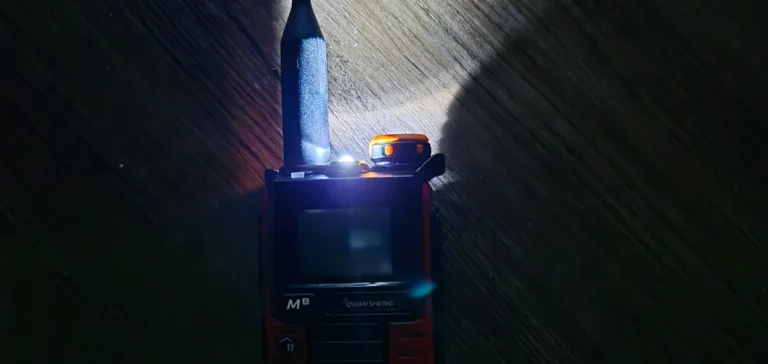
It has a Flashlight and a Backlit screen
I know we take power and light for granted here in the first world, but in a disaster scenario, all that goes out the window. When searching for a radio, I wanted to make sure I got one with a backlit screen so it could easily be used at night during a power outage. Getting a flashlight on the UV-K5 was just a bonus.
It has USB-C Charging (kind of)
I say “kind of” because the user manual says the USB-C port is only for emergency charging and you should stick to the standard cradle normal use.
Additionally, the USB-C port is pretty “dumb” meaning it won’t do power negotiation with modern USB-C chargers, so unless your USB-C cord has a full-size USB-A plug on the other side, it probably won’t work.
Full UV-K5 Specifications
These are the full Quansheng UV-K5 specifications, as per the Quansheng website and the UV-K5 user manual. I have translated from metric back into “freedom units” (ha!) where possible and highlighted the fields I think are most important.
If anything is unclear let me know in the comments below.
General UV-K5 Specifications
| Number of Channels | 200 |
| Number of FM Radios | 16 |
| Frequency Stability | ± 1ppm |
| Size (excluding antenna) | 4.5″ H x 2.4″ W x 1.5″ D (115mm x 60mm x 37.5mm) |
| Weight | 8oz (234g) |
| Working Temperature | -4°F to 140°F (-20°C to 60°C) |
| Antenna Impedance | 50Ω |
| Modulation Mode | FM: 11KOF3E (12.5KHz), 16K0F3E (25KHz) |
| Number of NOAA Channels | 10 |
| Battery Capacity | 1600mAh |
Reception Specifications
The following UV-K5 specs for receiving all use an audio power of >= 0.5W and have an audio distortion of <= 10%.
| FM Frequency at 12dB SINAD | Sensitivity |
|---|---|
| 50-76 MHz | -121dBm |
| 108-135.9975 MHz | -121dBm |
| 136-173.9975 MHz | -123dBm |
| 174-348.9975 MHz | -123dBm |
| 350-399.9975 MHz | -123dBm |
| 400-469.9975 MHz | -123dBm |
| 470-599.9975 MHz | -121dBm |
| Wide FM Frequency at 20dB SINAD | Sensitivity |
|---|---|
| 76-108 MHz | -110dBm |
| AM Frequency at 10dB S/N | Sensitivity |
|---|---|
| 108-135.9975 MHz | -113dBm |
Transmit Specifications
| Frequency Bands | 144-148 MHz 420-450 MHz |
| Transmit Power | <= 5W |
| Emission Current | <= 1.5A |
| Maximum Frequency Deviation | <= 5KHz (25kHz) <= 2.5KHz (12.5kHz) |
| Modulation Distortion | <= 5% |
| Stray Power | <= 7.5uW |
| Adjacent Channel Power | 70dB (25kHz) 60dB (12.5kHz) |
| Residual Modulation | 40dB |
Miscellaneous Features
Here is the final list of miscellaneous features called out in the gooUV-K5 specs.
- NOAA Weather Alerts
- Channel/Frequency Copy
- 10-Group Scrambler
- High Capacity Battery\Long Standby Time
- Built-in Flashlight
- Reverse Frequency Function
- Time-Out-Timer
- 1750HZ Call Tone
- Frequency And Channel Mode Shift
- 200 Channel
- Voice Prompt
- Multi-Band Transmitting & Receiving
- Emergency Alert
- Multi-Scan
- Offset Frequency Direction Set
- Offset Frequency Setting
- Wide/Narrow Bandwidth
- Squelch Level Adjustable
- Keypad Lock
- Backlight Auto Off Time Selective
- Cross-Band Intercom
- DTMF
- DTMF ANI
- Adjustable Squelch
- Selectable Transmit Power (H,M,L)
- Receive/Transmit Code Setting Separately
- Multi Step Frequency
- Channel Store
- PC Programmable
- Reminding Switch
- AM/FM Aviation Band Receiving
- FM Radio
- CTCSS/DCS
- Charger-base Charging
- VOX
- Auto Code Search
- Busy Channel Lock
- Multi Display Of Channel No./ Channel Frequency/Channel Name
- Channel Scan And Add
- Large LCD Display
- Repeater Forwarding Confirmation Function
- Power-on Password Protection
- Channel Delete
- One Key Call Channel
- Dual Display Of Frequency And Channel
What’s in the Box?
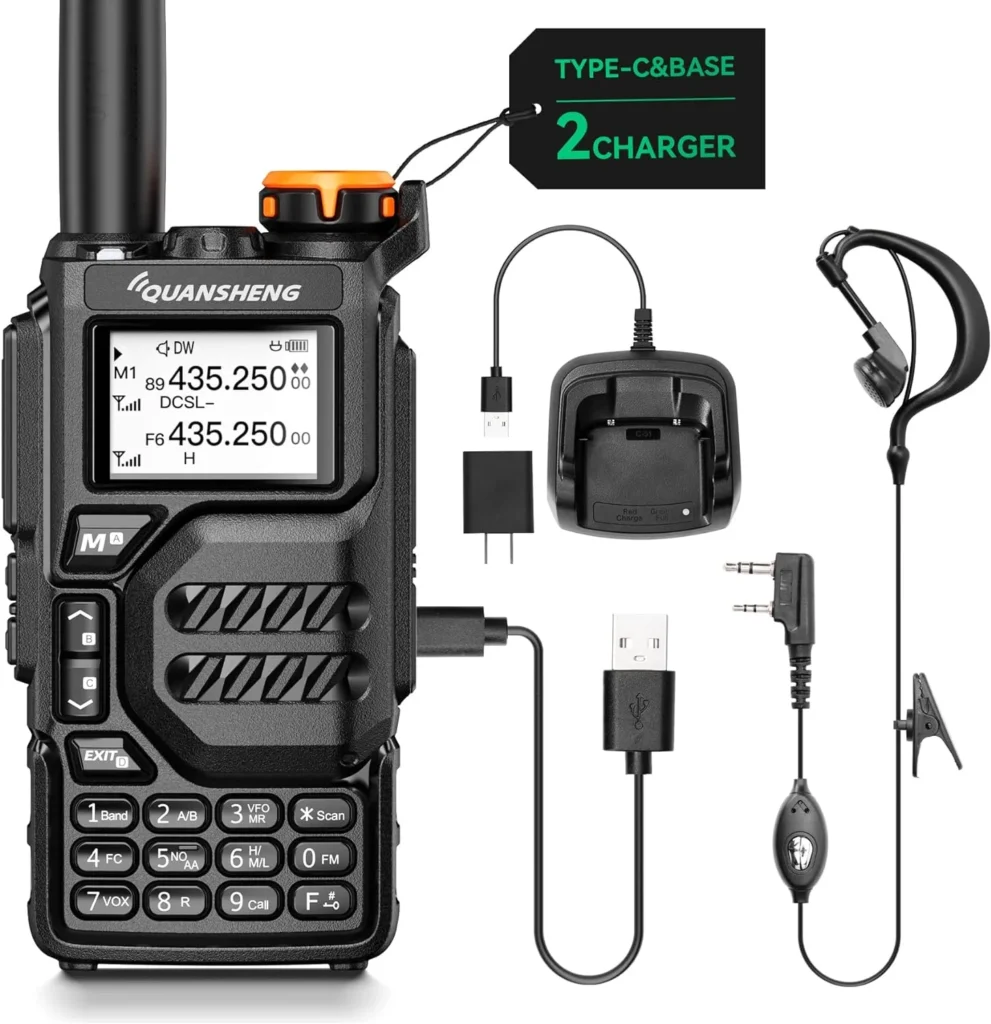
There are lots of Quansheng resellers on Amazon who bundle and package radios differently; however, each UV-K5 should come with the following:
- Quansheng UV-K5 Radio
- 1600mAh battery
- Detachable belt clip
- Wrist lanyard/string
- Detachable antenna
- Charging cradle
- USB-A to USB-C emergency charging cable
- Wired headset
- User manual
Conclusions
The UV-K5 was the first modern handheld radio from Quansheng and it’s still available for sale online today; however, if I was you, I wouldn’t buy it. Instead, look at the similarly-priced UV-K5(8)/UV-K6, UV-K5(99) variant, and the newly announced TK-11, all also available from Quansheng. If you compare the UV-K5 specs to the K5(8), K6, or K5(99), they all look pretty similar, but the TK-11 should be a pretty good upgrade.
One of these days I’ll get around to writing an official review of this UV-K5, so please stay tuned and let me know if I missed anything in my summary here.
Find the Quansheng UV-K5 on Amazon
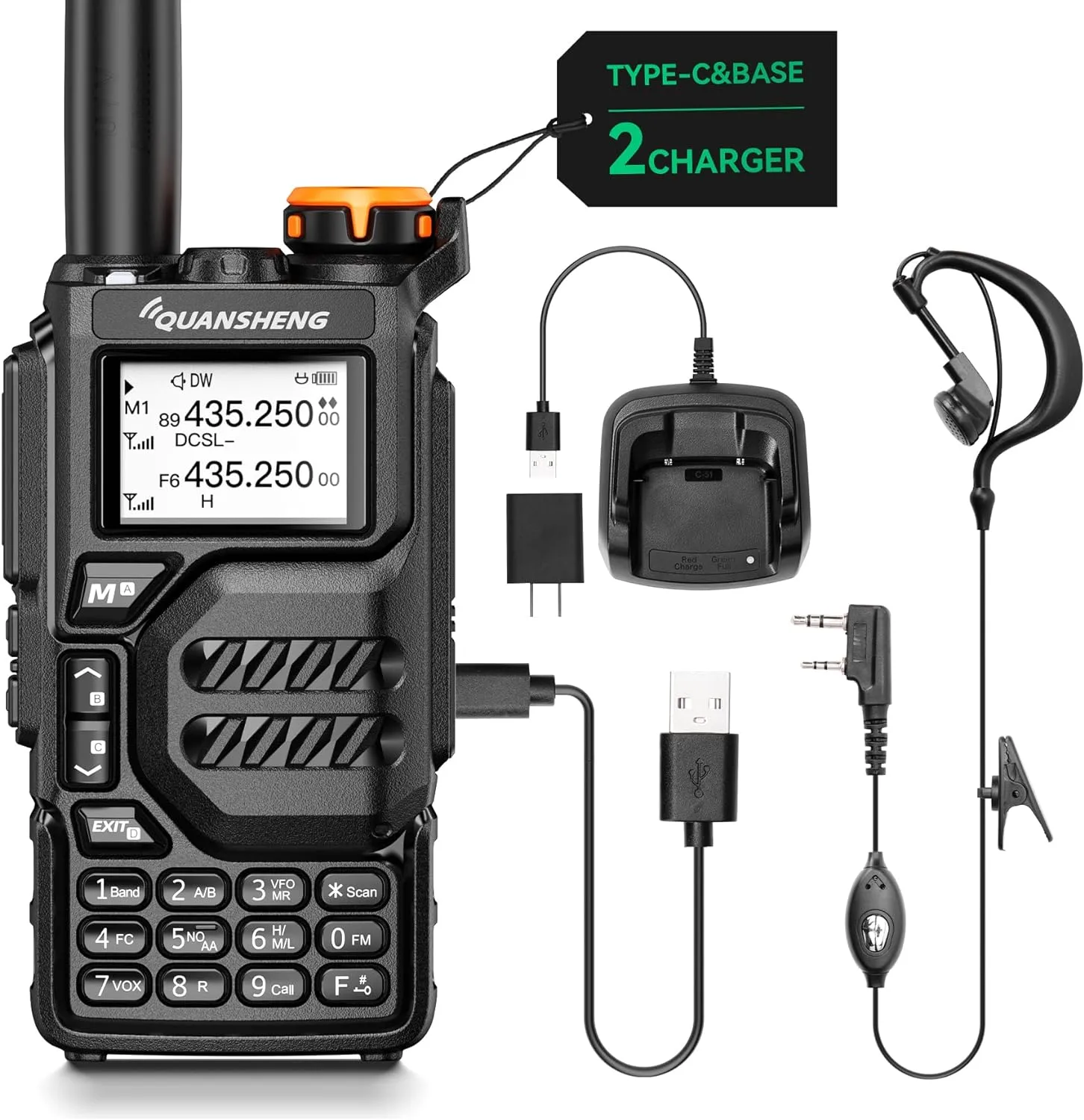
UV-K5 Walkie Talkie Dual Band 5W Rechargeable Two Way Radio NOAA Emergency Weather Receiver with Type-C Charging Cable, Headset (Black 1 Pack)
Quansheng UV-K5 Frequently Asked Questions
What’s the best UV-K5 firmware?
In early 2025, the general consensus seems to be that Egzumer Firmware is best. There are other choices out there like Kamil Nunu, F4HWN, and IJV 3, but Egzumer is the most popular.
Is the UV-K5 Legal in the USA?
Owning a UV-K5 is legal, but using it without an amateur radio license is not. Find out more in our legal article.